C3 HISTORY
The complete story of the third generation Chevrolet Corvette (1968-1982). Explore the evolution of one of America's most iconic sports cars through fifteen years of innovation, performance, and style.
The C3 Generation
The third generation Corvette, produced from 1968 to 1982, represents one of the most significant periods in Corvette history. Designed by Larry Shinoda under the direction of Bill Mitchell, the C3 introduced a dramatic new body style that would become one of the most recognizable automotive designs of the 20th century.
Over its 15-year production run, the C3 Corvette navigated the transition from the muscle car era through the emissions-controlled 1970s, adapting to changing regulations while maintaining its identity as America's premier sports car. From the high-compression big-blocks of the early years to the fuel-injected engines of 1982, the C3 evolved continuously while preserving the core values that made the Corvette legendary.
With over 540,000 units produced, the C3 remains one of the most successful and longest-running Corvette generations. Its combination of stunning design, impressive performance, and American engineering excellence created a legacy that continues to inspire enthusiasts today.
The Birth of the C3
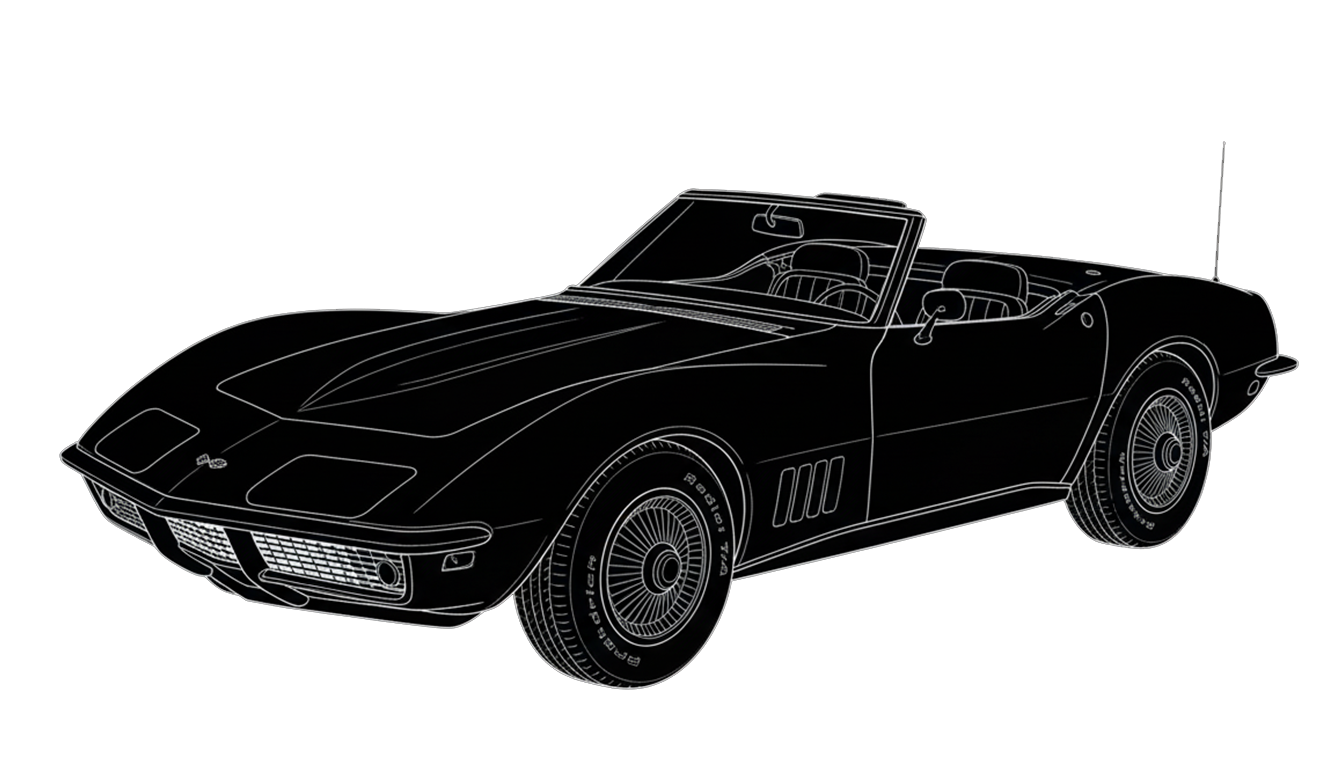
The 1968 Corvette marked the beginning of the third generation, introducing a completely redesigned body inspired by the Mako Shark II concept car. Designed by Larry Shinoda under the direction of Bill Mitchell, the new Corvette featured a dramatic fastback design with removable T-top roof panels -- a first for a U.S. production car. Despite its stunning looks, the first-year C3 was plagued by quality issues including vacuum system failures, water leaks, and poor panel fitment.
Key Highlights
- •First year of the C3 generation with all-new body design
- •Introduction of removable T-top roof panels (first U.S. production car with T-tops)
- •327 cubic inch small-block V8 as base engine (300 hp) with optional L79 327/350 hp
- •Optional 427 cubic inch big-block V8 in four variants: L36 (390 hp), L68 (400 hp), L71 (435 hp), and L88 (430 hp rated, 550+ hp actual)
- •Four-wheel independent suspension with transverse leaf springs carried over from C2
- •First year for vacuum-operated pop-up headlights (replacing C2 electric motor design)
- •First year for Turbo Hydra-Matic 3-speed automatic, replacing the 2-speed Powerglide
- •Only C3 year without the Stingray name badge
Key Features
- •Body-on-frame construction with fiberglass body panels
- •New Astro Ventilation flow-through system replaced C2 vent windows
- •Fiber optic light monitoring system allowed driver to check exterior lights from inside
- •Optional power windows ($57.95) and air conditioning ($412.90)
- •Available in both coupe and convertible -- convertible outsold coupe nearly 2:1
Notable Changes
- •Completely new body design inspired by the Mako Shark II concept
- •Wider front and rear track for improved stability (wheelbase unchanged at 98.0 inches from C2)
- •New dashboard layout with improved visibility
- •L88 high-performance option: only 80 produced, rated at 430 hp but actually producing 550+ hp, designed for racing
Performance
The base L30 327 V8 produced 300 horsepower. The optional L79 327 delivered 350 hp (9,440 sold -- the second most popular engine). The 427 big-block came in four variants: L36 (390 hp), L68 tri-carb (400 hp, 1,932 built), L71 (435 hp), and the legendary L88 (430 hp rated, 550+ hp actual, only 80 built). An L89 aluminum head option was available on the L71, saving 73 lbs (624 built).
Legacy
The 1968 Corvette established the design language that would define the C3 generation for 15 years. Despite first-year quality problems, its dramatic styling set a new standard for American sports cars. It remains the only C3 without the Stingray badge.
Refinement and the ZL1
The 1969 model year brought refinements to the C3 design and introduced the Stingray name (now one word, changed from the C2's 'Sting Ray'). A 16-month production cycle due to a UAW strike resulted in the highest C3 production to that point. This year also saw the legendary ZL1 all-aluminum big-block -- only two were ordered in Corvettes, making them among the most valuable American cars ever produced.
Key Highlights
- •Return of the Stingray name, now spelled as one word on the front fenders
- •ZL1 all-aluminum 427 big-block -- only 2 ordered in Corvettes (430 hp rated, 560+ hp actual)
- •First year for the 350 cubic inch small-block, replacing the 327
- •Side exhaust pipes (RPO N14) returned as a factory option for the first time on the C3
- •16-month extended production run due to UAW strike
- •Seven engine options offered -- the most of any C3 year
Key Features
- •Redesigned fender louvers with four vertical slots per side (replacing 1968 design)
- •Wider 8-inch wheels (up from 7-inch in 1968)
- •Smaller 15-inch steering wheel (down from 16-inch)
- •Ignition switch moved to steering column per federal safety regulations
- •Map pockets added to passenger dash area
- •New color options including Monza Red and Fathom Green
Notable Changes
- •350 CID small-block replaces 327 CID as the base engine platform
- •Stingray badge added to front fenders (absent in 1968)
- •Improved door handles, window mechanisms, and weatherstripping
- •L89 aluminum head option available on L71 engine ($832.05, saving 73 lbs)
Performance
Seven engine options spanned 300 to 435+ hp. The base 350 (RPO ZQ3) produced 300 hp. The L46 350 delivered 350 hp with 11.0:1 compression. Big-block 427s included the L36 (390 hp), L68 tri-carb (400 hp), L71 (435 hp), L88 (430 hp rated, 500+ hp actual, 116 built), and the ultra-rare ZL1 all-aluminum 427 (430 hp rated, 560+ hp actual, only 2 ordered in Corvettes).
Legacy
1969 is remembered for the ZL1 -- one of the most collectible Corvettes ever made, with surviving examples valued at $3 million+. The extended 16-month production run explains the high production numbers. The year also introduced the 350 small-block that would power every C3 through 1982.
The LT-1 Arrives
1970 was a landmark year with the debut of the LT-1 small-block engine, which became one of the most celebrated Corvette powerplants. The 454 cubic inch big-block also debuted, replacing the 427. However, a UAW labor dispute delayed production start until January 1970, resulting in only 17,316 units -- the lowest since 1962.
Key Highlights
- •Debut of the LT-1 350 V8 with 370 horsepower (solid lifters, 11.0:1 compression)
- •First year for the 454 cubic inch big-block (LS5, 390 hp), replacing the 427
- •Introduction of the ZR1 special performance package (LT-1 + heavy-duty everything, only 25 built)
- •New body-contour fender flares to reduce wheel-thrown debris
- •Lowest production since 1962 due to UAW strike
- •New egg-crate front grille design
Key Features
- •LT-1 engine: 370 hp at 6,000 RPM, solid lifters, 11.0:1 compression, Holley 4-barrel
- •LS5 454: 390 hp at 4,800 RPM, hydraulic lifters, 10.25:1 compression
- •L46 350/350hp option continued alongside LT-1 (4,910 built vs. 1,287 LT-1s)
- •Rectangular exhaust tips replaced round ones
- •Positraction rear axle, tinted glass, and wide-ratio 4-speed manual became standard
- •New deluxe interior option with redesigned seats
Notable Changes
- •454 big-block replaces 427 (the 427 was last offered in 1969)
- •New front fender vents with egg-crate styling
- •Body-contour fender flares added
- •LS7 454/460hp was catalogued but never delivered to customers due to strike-shortened year
Performance
Four engine options covered 300 to 390 hp. The base 350 produced 300 hp. The L46 350 delivered 350 hp and was the most popular optional engine (4,910 units, 28% of production). The LT-1 350 produced 370 hp from its high-revving solid-lifter design. The LS5 454 big-block produced 390 hp with massive torque.
Legacy
The LT-1 engine became legendary for its high-revving nature and reliability. 1970 is considered one of the best years for C3 performance, representing the last gasp of high-compression engines before emissions regulations took hold. The ZR1 package (only 25 built) is among the rarest and most collectible C3s.
The LS6 and Lower Compression
1971 marked the beginning of the decompression era as GM mandated all engines run on lower-octane fuel. Compression ratios dropped significantly across the lineup, with the most powerful engines falling from 11.0:1 to 9.0:1. Despite the lower ratios, the LS6 454 still produced an impressive 425 gross horsepower, making it one of the most powerful production Corvettes.
Key Highlights
- •Introduction of the LS6 454 with 425 gross horsepower (only 188 built)
- •Compression ratios dropped across all engines to accommodate lower-octane fuel
- •LT-1 continued at 330 gross hp (down from 370 in 1970 due to lower 9.0:1 compression)
- •Ultra-rare ZR2 special purpose package (LS6-based, only 12 built -- 1971 only)
- •ZR1 package continued (LT-1-based, only 8 built)
- •Last year for the fiber optic light monitoring system
Key Features
- •Four engine options: Base 350/270 hp, LT-1 350/330 hp, LS5 454/365 hp, LS6 454/425 hp
- •LS6: 9.0:1 compression, solid lifters, aluminum intake, 425 hp at 5,600 RPM
- •LT-1: 9.0:1 compression (down from 11.0:1), 330 hp at 5,600 RPM (1,949 built)
- •Last year for the M22 'Rock Crusher' heavy-duty 4-speed transmission
- •Last year for the headlight washer system
- •Air conditioning ordered on 52.7% of cars; power steering on 82.1%
Notable Changes
- •First year of reduced compression ratios (base/LS5 at 8.5:1, LT-1/LS6 at 9.0:1)
- •Minimal exterior changes from 1970 -- chrome bumpers and body panels carried over unchanged
- •Amber parking light lenses specified (though many shipped with clear lenses/amber bulbs)
- •LS5 detuned from 390 hp (1970) to 365 hp due to lower 8.5:1 compression
Performance
Despite lower compression, the LS6 454 produced 425 gross horsepower at 5,600 RPM with 475 lb-ft of torque -- making it one of the most powerful production Corvettes ever. The LT-1 delivered 330 hp (down 40 from 1970). The base 350 produced 270 hp, and the LS5 454 made 365 hp.
Legacy
1971 represents the last year GM offered truly high-output engines before the switch to SAE net ratings and tighter emissions controls. The LS6 454 (only 188 built) and ZR2 package (only 12 built) are among the most sought-after C3 Corvettes, commanding premium prices at auction.
The Last Chrome Bumper
1972 marked a turning point on two fronts: it was the last year for chrome bumpers (front and rear), and the industry switched from SAE gross to SAE net horsepower ratings, making published power figures appear dramatically lower even though the engines were mechanically unchanged from 1971. The 1972 is widely known among collectors as 'the last chrome bumper Corvette.'
Key Highlights
- •Last year for chrome bumpers, both front and rear
- •Horsepower ratings switch from SAE gross to SAE net across the industry
- •Last year for the high-performance LT-1 engine (255 hp net / 330 hp gross equivalent)
- •Last year for the removable rear window on the coupe
- •Last year for the egg-crate front grille and side fender gill vents
- •Only year the LT-1 could be ordered with factory air conditioning
Key Features
- •Three engines offered -- smallest lineup since 1956: Base ZQ3 350/200 hp net, LT-1 350/255 hp net, LS5 454/270 hp net
- •LT-1 and 1971 LT-1 were mechanically identical -- only the rating method changed
- •LT-1 with A/C required lowered redline to 5,600 RPM to accommodate the A/C belt
- •ZR1 special purpose package in its final year (only 20 built; 53 total across 1970-1972)
- •Anti-theft alarm system became standard
- •LS5 not available for California delivery due to emissions regulations
Notable Changes
- •SAE net horsepower ratings adopted industry-wide, making power appear much lower
- •Last year for chrome bumpers -- 1973 would introduce urethane front bumper
- •Last year for removable rear window on coupe (1973+ had fixed glass)
- •Last year for vacuum-operated pop-up windshield wiper door
Performance
The LT-1 was rated at 255 hp net (equivalent to the previous year's 330 hp gross -- the engines were identical). The base ZQ3 350 produced 200 hp net, and the LS5 454 made 270 hp net with 390 lb-ft of torque. While the numbers looked lower, actual performance was unchanged from 1971.
Legacy
1972 is prized by collectors as the last chrome-bumper Corvette and the final year for the legendary LT-1 engine. The ZR1 package ended its three-year run with only 53 total units built. The switch to net ratings marks the clear dividing line between the muscle car era and the emissions era.
The Urethane Bumper Arrives
1973 introduced the body-color urethane front bumper to meet federal 5 mph impact standards -- a dramatic visual change that eliminated chrome from the front of the car. The rear retained its chrome bumper, making 1973 the only C3 model year with this unique front-urethane/rear-chrome combination.
Key Highlights
- •New body-color urethane front bumper replaces chrome (5 mph impact standard)
- •Last year for the chrome rear bumper (replaced by urethane in 1974)
- •Introduction of the L82 high-performance small-block (250 hp net), replacing the LT-1
- •First year for steel-belted radial tires (GR70-15) -- a major handling improvement
- •Rear window permanently fixed (no longer removable as on 1968-1972 coupes)
- •40% reduction in cabin noise through extensive sound deadening
Key Features
- •Three engines: Base L48 350/190 hp net, L82 350/250 hp net, LS4 454/275 hp net
- •L82: hydraulic lifters (replacing LT-1's solid lifters), 9.0:1 compression
- •Urethane front bumper cover over steel impact bar, painted body color
- •Steel guard beams added inside doors for side-impact protection
- •Redesigned fender vents -- simpler recessed air vents replaced cast grilles
Notable Changes
- •Only C3 year with urethane front / chrome rear bumper combination
- •L82 replaces LT-1 as the performance small-block option (hydraulic lifters, less peaky power)
- •Fixed rear window ends the removable glass feature from 1968-1972
- •Aluminum wheels (RPO YJ8) were listed but recalled after approximately 4 sets sold due to porosity defects; the option returned in 1976
Performance
The L82 350 produced 250 hp net with 9.0:1 compression, delivering smooth power through hydraulic lifters. The base L48 350 made 190 hp net. The LS4 454 big-block continued at 275 hp net with substantial low-end torque.
Legacy
1973 marks the visual transition from the classic chrome-bumper era to the body-color bumper cars. Its unique one-year-only front-urethane/rear-chrome combination makes it instantly identifiable. The introduction of radial tires significantly improved handling characteristics.
The Last Big-Block and Convertible Era
1974 was a year of lasts: the final year for the 454 big-block engine, the last year before catalytic converters, and the last year for true dual exhaust. The Arab oil embargo (October 1973 - March 1974) cast a long shadow over the automotive industry and contributed to the end of the big-block era. The new rear urethane bumper completed the transition from chrome started in 1973.
Key Highlights
- •Last year for the 454 big-block engine in a Corvette (LS4, 270 hp net)
- •Last year before catalytic converters (introduced in 1975)
- •Last year for true dual exhaust (1975+ used Y-pipe with single catalytic converter)
- •Rear body-color urethane bumper introduced, matching the 1973 front
- •All engines required unleaded gasoline for the first time
- •Gymkhana Suspension (RPO FE7) introduced -- a $7 option with stiffer springs
Key Features
- •Three engines: Base L48 350/195 hp net, L82 350/250 hp net, LS4 454/270 hp net
- •Two-piece rear bumper with visible center seam -- unique to 1974 only (1975+ one-piece)
- •Integrated shoulder/lap belt combo new for coupes
- •Wider inside rearview mirror (10 inches, up from 8)
- •Radiator and shroud revised for improved low-speed cooling
- •First Corvette coupe to exceed $6,000 base price ($6,001.50)
Notable Changes
- •Rear urethane bumper cover over aluminum impact bar completes chrome-to-urethane transition
- •LS4 454 in its final year -- 3,494 units built
- •Convertible production declining (5,474 units, 14.6% of production)
- •Resonators added to exhaust for noise reduction
Performance
The LS4 454 produced 270 hp net with 380 lb-ft of torque in its final year. The L82 350 continued at 250 hp net with 285 lb-ft. The base L48 350 made 195 hp net. Turbo Hydra-Matic automatic was installed in roughly two-thirds of production, reflecting the shift from manual transmissions.
Legacy
1974 is significant as the last year a big-block engine was offered in the Corvette. It was also the last year before catalytic converters and the last year for true dual exhaust, closing the chapter on the muscle car era Corvette. The oil embargo provided the economic backdrop that made these changes inevitable.
Last Convertible, New Technology
1975 was defined by two historic milestones: it was the last year for the Corvette convertible (which would not return until 1986) and the first year for catalytic converters and HEI (High Energy Ignition). Zora Arkus-Duntov, the legendary 'Father of the Corvette,' retired this year, with Dave McLellan taking over as chief engineer.
Key Highlights
- •Last year for the convertible until 1986 (only 4,629 built, 12% of production)
- •First year for catalytic converters and unleaded fuel requirement
- •First year for HEI (High Energy Ignition) electronic ignition
- •Zora Arkus-Duntov retired; Dave McLellan became Corvette chief engineer
- •Single exhaust system with Y-pipe replaced true dual exhaust
- •First electronically driven tachometer, replacing distributor-driven unit
Key Features
- •Two engines: Base L48 350/165 hp net (8.5:1 compression), L82 350/205 hp net (9.0:1 compression)
- •L82 available with both manual and automatic transmission
- •Last year for the M21 close-ratio 4-speed manual (required L82 engine)
- •Catalytic converter required switch from dual exhaust to 2-into-1-into-2 Y-pipe
- •Speedometer added metric (km/h) markings for the first time
- •L82 not available for California delivery due to emissions
Notable Changes
- •Convertible discontinued after 1975 (final Corvette off the line was a convertible)
- •All engines now small-block 350 V8s -- no big-block option
- •HEI system improved cold starting and eliminated points maintenance
- •Last year for Astro Ventilation system
Performance
With only small-block engines available, the L82 at 205 hp net was the top performer. The base L48 produced 165 hp net. While power was down from previous years, the HEI system improved throttle response and the catalytic converter actually allowed slightly more aggressive tuning than would have been possible without it.
Legacy
1975 represents a pivotal transition: the end of the convertible era, the retirement of Duntov, and the embrace of emissions technology. The final convertible is a collector milestone. Only 4,629 were built, making them increasingly valuable.
Coupe Only, Stingray's Last Year
1976 was the first year with no convertible option and the last year the Stingray name appeared on the Corvette (it would not return until the 2014 C7). Despite these losses, production climbed to 46,558 units -- the highest since 1969 -- and both engines received meaningful power increases.
Key Highlights
- •First year with no convertible option (coupe only)
- •Last year for the Stingray fender nameplate (not used again until 2014 C7)
- •L82 power increased to 210 hp net (up from 205 in 1975)
- •Base L48 power increased to 180 hp net (up from 165 -- a significant 15 hp gain)
- •Aluminum wheels (RPO YJ8) returned after 1973 recall, saving 32 lbs unsprung weight
- •Delco 'Freedom' maintenance-free battery became standard, saving 13 lbs
Key Features
- •Two engines: Base L48 350/180 hp net (8.5:1 compression), L82 350/210 hp net (9.0:1 compression)
- •Steel floor panels replaced fiberglass between floor and catalytic converter for heat shielding
- •Vega-GT four-spoke steering wheel replaced previous design
- •Power steering and power brakes became standard mid-year (only 173 early cars shipped without power steering)
- •L82 not available in California due to emissions regulations
- •L82 ordered on 5,720 units (12.3% of production)
Notable Changes
- •Stingray badge removed from fenders after this year
- •Rear deck air-extractor vents and astro-ventilation removed; modified cowl induction replaced cowl flap
- •Steel floors improved structural rigidity and heat shielding from catalytic converter
- •15% of buyers selected optional aluminum wheels
Performance
The L82 produced 210 hp net at 5,200 RPM with 255 lb-ft of torque. The base L48 gained a significant 15 hp to reach 180 hp net at 4,000 RPM with 270 lb-ft of torque, partly enabled by improved catalytic converter tuning. Both engines used Rochester Quadrajet 4-barrel carburetors.
Legacy
1976 marks the end of the Stingray nameplate's first run and the beginning of the coupe-only era. Strong sales despite no convertible proved the coupe could carry the line. The meaningful power gains showed that engineers were learning to work within emissions constraints rather than just losing power each year.
The 500,000th Corvette
On March 15, 1977, the 500,000th Corvette -- a white coupe with red interior -- rolled off the St. Louis assembly line, marking a historic production milestone. The 1977 model brought numerous specific improvements including standard leather seats, redesigned controls, and the return of black as an exterior color for the first time since 1969.
Key Highlights
- •500,000th Corvette built on March 15, 1977 (white coupe, red interior -- now at the National Corvette Museum)
- •Leather seats became standard for the first time in Corvette history
- •Power steering and power brakes now standard on all cars
- •Black exterior paint returned for the first time since 1969 -- became second most popular color
- •Last year for the 'sugar scoop' tunneled roofline and vertical rear window (fastback in 1978)
- •New column-mounted 'Smart Switch' combining turn signals, dimmer, and wiper/washer controls
Key Features
- •Two engines: Base L48 350/180 hp net, L82 350/210 hp net (unchanged from 1976)
- •Steering column shortened 2 inches closer to dash for better driving position and easier entry/exit
- •Redesigned center console to accept broader array of Delco audio units
- •First AM/FM/cassette stereo option offered
- •New 'Electro-Clear' heated-element rear window defogger replaced forced-air defroster
- •L82 ordered on 6,148 units (12.49% of production)
Notable Changes
- •500,000th Corvette milestone celebrated during production
- •Leather seats standard (cloth-leather trim available as no-cost alternative)
- •Smart Switch stalk consolidated three separate controls onto one lever
- •Engine color changed from Chevy orange to blue during production run (August-September 1976 transition)
Performance
Engine specifications were unchanged from 1976. The L82 produced 210 hp net at 5,200 RPM with 255 lb-ft of torque at 3,600 RPM (9.0:1 compression). The base L48 made 180 hp net at 4,000 RPM with 270 lb-ft at 2,400 RPM (8.5:1 compression).
Legacy
The 500,000th Corvette milestone underscored the model's enduring popularity. 1977 is also the last year of the original C3 roofline -- the tunneled 'sugar scoop' rear window design that defined the generation from 1968 would be replaced by a fastback in 1978. Sales hit a new record at 49,213 units.
The 25th Anniversary and Pace Car
1978 was a landmark year: the Corvette's 25th anniversary, the introduction of the fastback rear window, and the first time a Corvette paced the Indianapolis 500. Two special editions were produced -- the Silver Anniversary Edition and the Indy 500 Pace Car Replica -- making 1978 one of the most collectible C3 model years.
Key Highlights
- •25th Anniversary Silver Edition with two-tone silver metallic over charcoal gray paint (15,283 built)
- •First Corvette to pace the Indianapolis 500; 6,502 Pace Car Replicas produced (one per dealership)
- •Introduction of the fastback rear window, replacing the 'sugar scoop' tunneled design used since 1968
- •L82 engine increased to 220 hp net
- •Pace Car featured front and rear spoilers, glass T-tops, and special black/silver paint with red pinstriping
- •First actual glove box in the C3 generation
Key Features
- •Two engines: Base L48 350/185 hp net (49-state; 175 hp California), L82 350/220 hp net
- •Silver Anniversary: two-tone silver metallic upper / charcoal gray lower with pinstriping; interior in black, oyster, or red
- •Pace Car Replica: black/silver two-tone with red pinstriping, glass T-tops, front/rear spoilers
- •Redesigned 'aircraft-style' center console with restyled gauges
- •Glass T-top panels introduced on Pace Car, later available on other models
- •L48 production: 34,037 units; L82 production: 12,739 units
Notable Changes
- •Fastback rear window replaced the 'flying buttress' tunneled roofline used from 1968-1977
- •Fastback design improved rear visibility and luggage access
- •New dashboard gauges and center console layout
- •Base price approximately $9,351.89 -- approaching the $10,000 mark
Performance
The L82 increased to 220 hp net, while the base L48 produced 185 hp net for 49-state cars (175 hp for California/high-altitude versions). Both engines were 350 CID with Rochester Quadrajet 4-barrel carburetors. The L82 had 8.9:1 compression; the L48 had 8.2:1.
Legacy
The 1978 Silver Anniversary Edition and Pace Car Replica are among the most recognizable and collectible C3 models. The fastback rear window transformed the car's profile and continued through the end of the generation. Pace Car Replicas generated enormous dealer demand, with many selling above sticker price.
All-Time Production Record
1979 set a production record of 53,807 units -- not just for the C3, but for ALL Corvette generations, a record that still stands. Both engines received power increases, the base price exceeded $10,000 for the first time, and the high-back seats from the 1978 Pace Car became standard equipment.
Key Highlights
- •All-time Corvette production record: 53,807 units (still stands as of 2026)
- •Base price exceeded $10,000 for the first time ($10,220.23)
- •High-back seats from 1978 Pace Car became standard (saving 24 lbs per pair)
- •L82 increased to 225 hp net; L48 increased to 195 hp net
- •AM-FM radio became standard equipment for the first time
- •Bolt-on front and rear spoilers (from 1978 Pace Car) available as regular option
Key Features
- •Two engines: Base L48 350/195 hp net (8.2:1 compression), L82 350/225 hp net (8.9:1 compression)
- •High-back bucket seats standard (previously Pace Car exclusive), passenger seat folded flat for cargo
- •Tilt-telescopic steering and power windows became standard
- •Tungsten-halogen high-beam headlights phased in during early production
- •Dual-snorkel air intake (previously L82-only) added to L48; new 'open flow' mufflers on both engines
- •Last year the L82 could be ordered with a manual transmission
Notable Changes
- •Record production driven by strong demand and efficient assembly
- •Both engines gained power: L48 up 10 hp (185 to 195), L82 up 5 hp (220 to 225)
- •Redesigned steering column moved wheel 2 inches closer to instrument panel
- •Automatic transmission rear axle ratio changed from 3.08:1 to 3.55:1 for better acceleration
Performance
Both engine options saw power increases. The L82 reached 225 hp net at 5,200 RPM with 270 lb-ft of torque. The base L48 climbed to 195 hp net at 4,000 RPM with 285 lb-ft. The gains came from the dual-snorkel air intake now standard on the L48 and new open-flow mufflers on both engines.
Legacy
1979's 53,807 units remains the all-time single-year Corvette production record across all generations. The continued power increases proved that performance could improve even within emissions constraints. The $10,000+ price point reflected the Corvette's evolution from sports car to grand tourer.
Weight Loss and the California 305
1980 was defined by an aggressive weight reduction program that shed roughly 250 pounds, integrated aerodynamic spoilers that dropped the drag coefficient from 0.503 to 0.443, and the controversial California-only 305 cubic inch V8 -- the smallest Corvette engine since 1955. TIME magazine would later list the California 305 among the '50 Worst Cars of All Time.'
Key Highlights
- •Approximately 250 lbs shed through aluminum components, thinner body panels, and lighter materials
- •California-only LG4 305 V8 (180 hp) -- smallest Corvette engine since 1955 (3,221 built)
- •Integrated front and rear spoilers reduced drag coefficient from 0.503 to 0.443
- •L82 reached 230 hp net -- peak small-block power for the emissions era
- •Last year for the L82 engine option
- •85 mph speedometer mandated by federal regulation
Key Features
- •49-state engines: Base L48 350/190 hp net, L82 350/230 hp net
- •California-only: LG4 305/180 hp net (mandatory for CA buyers; $50 credit for the downgrade)
- •Weight savings: aluminum differential housing/crossmember, thinner hood and door skins, lighter roof panels, aluminum intake standard on L48
- •Integrated spoilers increased radiator airflow by 50%
- •Power windows, air conditioning, and tilt-telescopic steering all became standard
- •Crossed-flags emblem removed from front fenders
Notable Changes
- •Major weight reduction program across body, chassis, and drivetrain
- •Aerodynamic body-integrated spoilers replaced bolt-on units
- •California emissions requirements forced the 305 V8 -- a deeply unpopular move
- •California 305 used the C-4 (Computer Controlled Catalytic Converter) system; 49-state 350s had no computer controls
Performance
The L82 350 reached 230 hp net -- the highest C3 power rating since the switch to net ratings. The base L48 350 made 190 hp net. The California LG4 305 produced just 180 hp from its smaller displacement. The 250-lb weight reduction partially offset the lower power in California cars, but the 305 was widely criticized.
Legacy
1980 is remembered for the ambitious weight reduction that improved handling and performance, the aerodynamic improvements, and the infamous California 305 that remains a cautionary tale about emissions over-compliance. The L82's peak of 230 hp marked the high point of emissions-era small-block performance.
Bowling Green and a New Era
1981 was defined by the historic move from the St. Louis assembly plant to the new Bowling Green, Kentucky facility. For about two months (June-August 1981), Corvettes were built at both plants simultaneously. This was also the first year for the Computer Command Control (CCC) system, the last year a manual transmission was available, and the only engine offered was the L81 350 at 190 hp.
Key Highlights
- •Production moved from St. Louis to Bowling Green, Kentucky (first Bowling Green Corvette: June 1, 1981)
- •First year for Computer Command Control (CCC) closed-loop fuel metering with oxygen sensor
- •Last C3 year with a manual transmission option (4-speed; would not return until late in 1984 C4)
- •Single engine offered: L81 350/190 hp -- first time only one engine available since 1954
- •First use of fiberglass mono-leaf rear spring (8 lbs vs. 44-lb steel multi-leaf)
- •Stainless steel exhaust manifolds and magnesium valve covers (first for a Chevy small-block)
Key Features
- •L81 350 V8: 190 hp at 4,200 RPM, 280 lb-ft torque, 8.2:1 compression, Rochester Quadrajet 4-barrel
- •CCC system: closed-loop fuel metering with oxygen sensor improved drivability and economy
- •Fiberglass mono-leaf rear spring limited to base suspension with automatic transmission
- •RPO D84 two-tone paint option unique to 1981 (four color combinations available)
- •New six-way power driver's seat that finally reclined
- •Standard quartz clock; electronic tuning for all factory radios
Notable Changes
- •Bowling Green plant built specifically for Corvette production -- improved quality control
- •Two-tone paint option introduced at Bowling Green
- •Stainless steel exhaust manifolds saved 14 lbs over cast iron
- •Only 4-speed manual or Turbo Hydra-Matic automatic available (last year for manual)
Performance
The sole L81 engine produced 190 hp net at 4,200 RPM with 280 lb-ft of torque. CCC's closed-loop fuel metering with oxygen sensor and torque converter lockup clutch improved both drivability and fuel economy compared to previous years' open-loop systems.
Legacy
The move to Bowling Green gave the Corvette its own dedicated factory for the first time, setting the stage for improved build quality that would carry into the C4 era. The end of the manual transmission option (only 13.7% of buyers chose it) reflected changing buyer preferences. The fiberglass rear spring and magnesium valve covers foreshadowed the lightweight materials that would define future Corvettes.
The Final Year
1982 marked the end of the C3 generation after 15 years of production. This final year featured the Collector Edition, the return of fuel injection for the first time since 1965 (a 17-year absence), and the new 700-R4 4-speed automatic -- the first Corvette offered exclusively with automatic transmission and no manual option.
Key Highlights
- •Final year of C3 production after 15 years (1968-1982)
- •Collector Edition with silver-beige paint and opening rear hatch glass (6,759 built)
- •Cross-Fire Injection (twin throttle body fuel injection) -- first Corvette fuel injection since 1965
- •L83 Cross-Fire Injection engine: 200 hp net (a 10 hp increase over the 1981 L81)
- •New 700-R4 4-speed overdrive automatic -- no manual transmission available
- •First Corvette to exceed $20,000 (Collector Edition: $22,537.59)
Key Features
- •L83 350 V8: 200 hp at 4,200 RPM, 285 lb-ft torque at 2,800 RPM, 9.0:1 compression
- •Cross-Fire Injection: twin Rochester throttle bodies on a special intake manifold
- •Collector Edition: silver-beige paint (code 59), beige leather interior, opening rear hatch glass (foreshadowing C4), finned aluminum wheels inspired by 1963 Sting Ray
- •700-R4 automatic: overdrive 4th gear with torque converter lockup improved highway economy
- •Automatic-only transmission -- first Corvette ever with no manual option
- •Base coupe price: $18,290; Collector Edition: $22,537.59
Notable Changes
- •Fuel injection returns after 17-year absence (last Rochester Ramjet FI was 1965, not 1962)
- •Collector Edition's opening rear hatch glass -- first on a Corvette, previewing C4 design
- •L83 produced 10 more hp than the 1981 L81 it replaced (200 vs. 190)
- •Compression ratio increased to 9.0:1 (up from L81's 8.2:1)
Performance
The Cross-Fire Injection L83 produced 200 hp net at 4,200 RPM with 285 lb-ft of torque -- a 10 hp increase over the 1981 L81. The higher 9.0:1 compression ratio (up from 8.2:1) and fuel injection improved both power and fuel economy. The 700-R4's overdrive 4th gear significantly improved highway cruising.
Legacy
The 1982 Collector Edition is one of the most sought-after C3 models, with its opening hatch glass and Sting Ray-inspired wheels pointing toward the future C4. Over the C3's 15-year run, approximately 542,741 units were produced, making it one of the longest-running and most successful Corvette generations. The return of fuel injection signaled the technology-driven direction the Corvette would take with the C4.